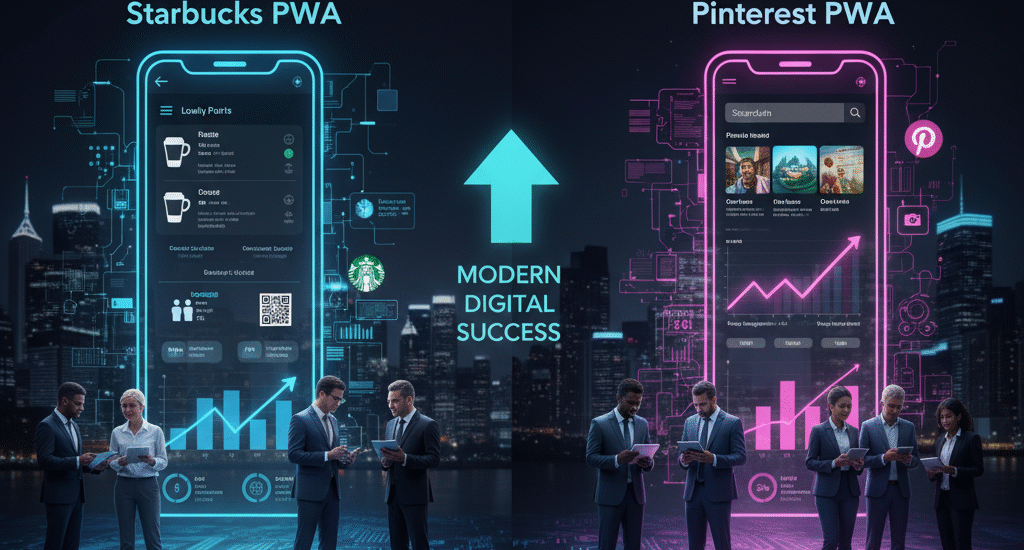
In today’s mobile-first world, users expect instant loading, seamless navigation, offline functionality, and app-like engagement—even if they’re browsing the web. This shift in expectations has pushed global brands to look beyond traditional mobile apps and move toward Progressive Web Apps (PWAs). Two of the world’s most widely recognized brands—Starbucks and Pinterest—have achieved remarkable growth using PWAs, setting benchmarks for digital experiences.
In this blog, we’ll explore how these companies transformed user engagement, conversions, and revenue through PWAs, and why brands across industries are now partnering with a progressive web app development company to replicate the same success.
What Makes PWAs So Powerful?
Before diving into the case studies, it’s crucial to understand what makes PWAs a game-changing technology:
-
Offline Access through advanced caching
-
Lightning-fast performance
-
Push notifications like native apps
-
No downloads required
-
Cross-device compatibility (mobile, desktop, tablet)
-
Installable on home screens
-
Better SEO visibility since PWAs are web-based
-
Low development cost compared to native apps
These capabilities have allowed companies like Starbucks and Pinterest to overcome performance issues, reduce friction, and scale their global digital presence.
⭐ Case Study 1: Starbucks — A Global PWA Success Story
Starbucks has one of the most widely used mobile ordering systems in the world. But a majority of users in emerging markets had limited connectivity, low-end devices, and storage constraints. The native app, while effective, wasn’t accessible to everyone.
The Challenge
-
Slow load times on low-bandwidth networks
-
High app size, leading to low installs in developing nations
-
Need for a unified experience for both mobile web and native app users
Starbucks wanted an app-like UX that didn’t require downloads or heavy data usage.
The PWA Solution
Starbucks collaborated with modern tech partners to rebuild their ordering experience as a Progressive Web App, reducing friction for millions of mobile users.
The result?
💡 A PWA that is only 233 KB in size—99% smaller than their native iOS app!
The Results Starbucks Achieved
1. User Engagement Doubled
With blazing speed and offline access, Starbucks saw a 2× increase in daily active users on the PWA compared to their previous mobile site.
2. Offline Ordering Boosted Conversions
The PWA allows users to browse the menu, customize items, and add items to cart—even offline. Orders sync automatically when the connection returns.
3. Massive Global Reach
Many users in emerging markets rely on 2G/3G networks and low-budget smartphones. The PWA solved this by consuming minimal resources.
4. App-like Experience Without Installing Anything
Starbucks realized users prefer quick access over heavy downloads. The PWA acted like a native app but lived in the browser.
Why the Starbucks PWA Worked
-
Ultra-light and extremely fast
-
Built for low connectivity regions
-
Offers complete cart functionality offline
-
Mirrors the native app’s design + experience
Starbucks’ digital transformation proved that performance is revenue—and PWAs deliver both.
⭐ Case Study 2: Pinterest — Turning Decline Into Explosive Growth
Pinterest is known for inspiration-driven content, but they struggled to convert mobile web users. In fact, only 1% of mobile web users were signing up or logging in. Slow performance and poor UX were major barriers.
The Challenge
Pinterest discovered:
-
Their mobile website converted very poorly
-
Load speed was extremely slow
-
Users rarely engaged beyond the first page
This was costing Pinterest millions in revenue and new user growth.
The PWA Solution
Pinterest rebuilt their entire mobile web experience into a full-fledged Progressive Web App, focusing on speed, accessibility, and deeper engagement.
The Results Pinterest Achieved
1. 60% Increase in Core Engagement
Users interacted more with the PWA due to instant loading and smoother UI.
2. 40% Higher Time Spent
With improved layout, transitions, and caching, users spent significantly more time exploring content.
3. 44% Higher User Revenue
The PWA brought Pinterest’s user monetization on mobile web closer to their native app numbers.
4. 50% Increase in Ad Click-through Rates
Because performance improved drastically, users viewed and clicked more ads, boosting ad revenue.
5. 15% Faster Performance Score (Google Lighthouse)
Pinterest improved their performance score from 32 to 90—an enormous jump.
6. 900 KB → 150 KB
Just like Starbucks, Pinterest reduced their app size dramatically, making it more accessible globally.
Why Pinterest’s PWA Strategy Worked
-
Minimal friction
-
App-like transitions
-
Lightning-fast image loading
-
Push notifications for re-engagement
-
Better SEO ranking
Pinterest’s PWA is now considered one of the best PWA success stories globally.
💡 Key Takeaways: Why Leading Brands Prefer PWAs
Starbucks and Pinterest aren’t alone. Brands like Uber, Twitter, AliExpress, Trivago, Tinder, and Flipkart have also adopted PWAs—and for good reasons.
PWAs help companies achieve:
-
Faster load times
-
Higher conversions
-
Lower bounce rates
-
More global reach
-
Better SEO visibility
-
Reduced app development & maintenance cost
For startups and enterprises alike, PWAs offer the perfect balance between performance and affordability.
🔧 Business Benefits: Why Your Brand Should Consider a PWA
1. PWAs reduce development time by 40–60%
Instead of building separate iOS, Android, and web apps, a PWA covers all channels.
2. Perfect for low-bandwidth regions
If your business serves emerging markets, PWAs can dramatically increase adoption.
3. Installable without app stores
No app store friction = more users.
4. High engagement through push notifications
Brands can send offers, alerts, reminders, and personalized messages.
5. Lower cost than native apps
Ideal for companies with limited budgets or aggressive timelines.
🏆 Why Companies Hire a Progressive Web App Development Company
Building a high-performance PWA like Starbucks or Pinterest is not simple. It requires:
-
Deep knowledge of service workers
-
Advanced caching techniques
-
Backend optimization
-
Security configuration
-
Responsive UI development
-
Lighthouse optimization
-
Push notification setup
-
Cross-browser compatibility
That’s why enterprises prefer working with an experienced progressive web app development company that understands scalability, performance engineering, and multi-device user behavior.
A skilled PWA partner can ensure your app performs flawlessly across all geographies—even in limited network conditions.
🏅 How the Best Mobile App Development Company Helps You Scale
While PWAs reduce development overhead, successful implementation still depends on:
-
Understanding user journeys
-
Crafting intuitive UI/UX
-
Creating an offline-first architecture
-
Integrating analytics
-
Ensuring SEO compatibility
-
Maintaining long-term updates
The best mobile app development company combines PWA engineering with traditional mobile app expertise, helping brands:
-
Launch faster
-
Reduce costs
-
Improve performance
-
Achieve better ROI
-
Scale globally
📌 Final Thoughts: PWAs Are the Future of Web + Mobile
Starbucks and Pinterest proved one thing clearly:
PWAs are not just a trend—they are the future of mobile experience.
Their success stories show how the right technology can:
-
turn slow experiences into high-conversion funnels
-
transform global accessibility
-
increase user engagement
-
boost revenue
For any business looking to scale digital experiences, a PWA is a forward-thinking investment.
If your brand is considering upgrading its mobile experience, partnering with a progressive web app development company could help you unlock the same growth that Starbucks and Pinterest achieved.